Jaisalmer, one of the most beautiful city of Rajasthan, evokes a cluster of associations in the minds of travelers, a golden fort, golden desert sands and elaborated carved havelis. It is a wonderful place to visit in the winter. The city is divided into two nearly equal haves, the town at ground level and the fort upon Trikutta Hill, both of which provide plenty of visual vision pleasure.
Rawal Jaisal built the Jaisalmer fort in 12th Century. The fort can be accessed by a ramp winding through five massive gates. There is a large courtyard known as Dussehra Chowk, from where you can view the Royal Palace, or Raj Mahal. Inside the fort is a complex of 7 Jain temples built in the 15th and 16th century. The Parshvanath temple is the most impressive of these. It has finely carved torana and the ceiling of the sabha mandapa, which supports a demonic looking head surrounded by five bodies. And as we walk around the Mandapa the head seems to connect, in turn which each of its bodies. Another highlights of the complex are the poky little basement called the Gyan Bhandar, under the gaudy coloured dimly lit Sambhavanath Temple. The other major monument in the fort is the Rajmahal, the erstwhile royal residence, which is now converted into the Jaisalmer Fort Palce Museum and Heritage Centre.
There are three 19th century havelis at the ground level foremost between which is the Patwa Haveli. This is also known as the Patwon- ki- Haveliyan, because there are actually five different houses. These havelis are perhaps, the last truly great Indian buildings constructed without a trace of European influence. Two of these Patwa havelis are government run.
Not far from the town centre is the Gadisar Lake, formerly, which is also the Jaisalmer’s chief water source. It is a charming picnic spot. To get it to it, we crossed an imposing gateway called Tilon ki Pol. there’s a domed pavilion in the centre of the water. You can also do boating, as the paddleboats are available.
The Jaisalmer Folklore Museum situated nearby contains a few puppets and traditional items of daily use, the Desert culture Centre and Museum displays fossils, coins and musical instruments.
The lanes inside the fort are packed with shops selling fabrics replete with embroidery and mirror work.
You can take a jeep to the Sam sand Dunes, 42 km from Jaisalmer, hop on to a camel for an hour around sunset and then get back to your comfortable hotel bed or else find a fancy tent to stay in for night. At the other end of the scale, you can ride for days with only a camel driver for company and the most basic provisions. The best option for reasonably hardy travelers is a 2-day safari with one night spent under the immense canopy of the desert sky. Lying under the open sky at night, with a dune entirely to you
Showing posts with label camping. Show all posts
Showing posts with label camping. Show all posts
Monday, August 6, 2007
Jaisalmer, The Alchemist’s Fort
Tuesday, July 31, 2007
Sariska National Park, ancient tiger lands.
 Sariska wildlife sanctuary is green, serene and was the hunting preserve of the Alwar royals, and its palace has been privy to many of these shoots. There is the sight of first hill burnished with the rust leaves of dhok, as one crosses over the hill into Kalighati Valley. There is a leaf – fringed avenue of dhok that greets the visitor at the old gate leading to Kankwari, overgrown on both sides with old trees of guler and pilkhan. Then there is a site of an explosion of blue- breasted quail, of the deep pools of the Siliberi Nala flowing down from Pandupol and of Pallas fishing edges watching for prey from nearby evergreen trees. I still treasure these memories from my numerous visits to Sariska.
My last tiger sighting at Sariska, one hot April was in the grassland just beyond Kalighati. Sariska was established as a Tiger Reserve in 1978. Before independence, the reserve was part of the erstwhile Alwar state. There are 16 revenue villages and associated cattle camps inside its boundaries. Almost all of the Sariska is hilly terrain dominated by the Aravallis, which run north- south along the park. Two vast plateaus Kanwari and Keraska top the Aravalli. There are three large lakes within the boundary of the park: Mangalsar, Sillserh and Somasagar.
Early morning and evening are the best times to make trips into
 Sariska National Park, though chances of spotting the cat are few and far between. That’s just not on the account of the diminishing tiger population, but more on account of the terrain like the undulating low hills, wide valleys and hill plateaus are hardly ideal for tiger spotting.
You would be easily able to view the nilgai, chital, langur cavorting through the tree cover. And by luck you might also view the tigers, leopard, jackal, with dogs and hyena. However birdwatchers can spot the white- breasted kingfisher, serpent eagle, great Indian horned owl and other avian species quite easily.
The most enjoyable part is the drive through the park where paths are dip down into the valleys and sinister shadows cross the jungle. If you want to do a cross-country jungle safari, then book one of the authorized forest jeeps well in advance at one of the two hotels Tiger Den and Sariska Palace.
When you are done with the animals, drive down into the Sariska forests to the ruined fortress atop a solitary hillock at Kankwari. Here emperor Aurangzeb imprisoned his elder brother widely held to be the legitimate successor to the throne of Delhi. From Kankwari move on to Neelkanth, a temple town near Tehla builds by the Gurjar Partiharas. Neelkanth was mysteriously submerged under a deluge of sand and rocks centuries ago, and nobody around knows what made the town suffer such a fate. The Naldehwar shrine nearby attracts hordes of pilgrims and picnickers- the former to the natural shivaling formed within an old tree trunk in the higher reaches of the forest, the latter to the little brook and seasonal waterfall at the base of 364 steps you have to climb to reach the lingam.
 Sariska has only two choices to stay, a heritage hotel and Rajasthan tourism property Sariska Palace and Tiger Den. There are no options to dine apart from your hotel. However a visit to one of Alwar’s most popular eateries, the Prem Pavitra Restaurant is a must.
Wednesday, July 11, 2007
Nandi Hills, weekend destination from Bangalore
Nandi Hills
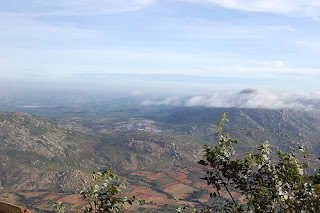 Nandi Hills are flat surroundings plains just outside Bangalore. The hills get their name from the beautiful statue of Nandi standing guard outside the Yoganandeeshwara Temple atop the hills.
 Nandi Hills are flat surroundings plains just outside Bangalore. The hills get their name from the beautiful statue of Nandi standing guard outside the Yoganandeeshwara Temple atop the hills.
Reaching the top is easy as there’s a good, mortable road going all the way up. Nandi hills are the place where laziness can be perfected into an art form. The most strenuous activities here are long ambles along the walkways meandering along the hills.
Tipu’s drop, a near 2,000 ft- high sheer cliff has a gory past. It is the place from where convicted prisoners would be hurdled to their death by Tipu Sultan’s decree. From here you would be able to view Bangalore in the distance sparkling beneath you like a giant rangoli decorated with diyas.
Yoganandeeshwara Temple is the abode of Shiva the ascetic at the top the hills was build by the Cholas. This ancient temple also has an inscription in the name of Sambhaji, son of Chhatrapati Shivaji.
Amrita Sarovar is a large tank fed by perennial springs and is called the lake of ambrosia. People visit it in night when it shimmers in the moonlight. Nearby lies the chabootra or platform where Tipu Sultan used to pray.
Nehru Nilaya is the house where Nehru lived in, however now it is a guest house belonging to the Horticulture Department.
Bhognandeshwara Temple is at the base of the Nandi Hills. Nandi hills have only two accommodation options one is the Hotel Mayura Pine Top and the second one is Nehru Nilaya.
Nandi Hills is blessed with a pleasant climate all year round.

Bheemeshwari, weekend destination from Bangalore
 A barefoot walk along the river’s edge, sipping coffee on the verandah of your cabin overlooking the river, being woken up by monkey’s jumping on your tent, are the view here. Nature treks into the wilderness, coracle rides, kayaking, outdoor camping, amateur fishing and professional angling. You may catch glimpse of rare species of birds, wild elephants and sloth bears.
Bheemeshwari’s Cauvery Fishing camp and two more camps at Doddamakkalli and Galibore along the Cauvery are run by Jungle Lodges as wildlife retreats and adventure resorts.
Mahseer is the angler’s paradise as one of the best fishing Camps in the world. The camp also conducts amateur fishing with guides to help you learn the ropes. The camp allows 10 lines for the season for professionals, so book well in advance as the camp is in high demand from angler’s across the globe.
Wildlife Treks are conducted in three categories easy,
 medium and tough ranging from a 4- 30 km distance. The treks take you to the neighboring hills, full of wildlife and plants used in ayurveda. You can also view the rural life as you pass through some of the villages.
Boat rides in coracles and barbecues at sun down along the river’s edge are the extras here. Swimming is not allowed because of crocodiles in the water.
Doddamkkali is 7 km upstream from Bheemeshwari is deep in the forest in a valley ideal for lovers who are willing to rough it out. Galibore 16 km downstream however involves a more circuitous route by road which takes almost 1 ¼ hours. Both camps are similar to Bheemeshwari and offer similar activities, but on smaller scale as they not provide electricity.
In Bheemeshwari you can stay at The Cauvery Fishing Camp which has 9 Swiss tented cottages and long 8 huts. Galibore Fishing Camp has 10 Swiss twin-bedded cottages with attached loos and many more.
Wednesday, July 4, 2007
Jim Corbett National Park
 Corbett, the first national park and tiger reserve in India, is located in the valley of the Ramganga River near the foothills of the Himalayas. Its proximity to Delhi and its wildlife make it a must visit destination for residents and guests tempted to go beyond the capital of India. While visiting Corbett you would be able to stay right within it at Dhikala and other forest rest house.
For birdwatchers, there are over 580 species to view; moreover you can also view reptiles such as turtles and gharial. All of which make Corbett one of the most complete wildlife experiences, besides being close enough to them without any hesitation.
Tourists are only allowed restricted entry by permit into about 100km of the tiger reserve area. You can enter them through Dhikala from the Dhangarhi gate, Bijrani from the Amdanda gate and Jhirna from the Dhela gate. Permission to enter the park are issued at the Tourist Reception Centre or the park’s entrance gate at Dhangarhi for Dhikala which is also the main center of activity in the park.
Visitors must move around in the park by car or jeep, accompanied by a licensed guide and most important walking is strictly prohibited and if found you will be arrested. There are few private resorts spread out and the forest department also provides few rest houses in the reserve area. Entry fee for Indians is Rs 30; foreigners Rs. 350, for elephant ride Indians Rs. 100, foreigners Rs 200 and a licensed guide Rs. 75 per trip.
You can also take a safari among the muddy tracks of Corbett lined with shoulder high grass on both the side or hire a vehicle from the forest Department or various tour organizers. You should carry a pair of binoculars, water and a heat gear. You might not be lucky enough to sight a tiger but you might certainly hear the roar of one or see the tiger’s pugmarks or his half eaten kill. Full jeep hire costs Rs700 from KMVN. Private jeeps are also available outside the park gates at Rs500-600 for the trip.
 Clambering onto an elephant is the most promising way of tracking tigers. Plus you would also feel safe when you spot tiger while the elephant moves up closer to give you a better view. Also try the elephant safari at least once, preferably in the evening. Make your booking at the Forest Department well in advance as these rides are popular and get fully booked very soon. Fishing is not allowed inside the reserve.
Corbett also has many resorts in the area, which are full of vacationers on weekends for part of the year when the park is closed. So do book in advance.
 Corbett, the first national park and tiger reserve in India, is located in the valley of the Ramganga River near the foothills of the Himalayas. Its proximity to Delhi and its wildlife make it a must visit destination for residents and guests tempted to go beyond the capital of India. While visiting Corbett you would be able to stay right within it at Dhikala and other forest rest house.
For birdwatchers, there are over 580 species to view; moreover you can also view reptiles such as turtles and gharial. All of which make Corbett one of the most complete wildlife experiences, besides being close enough to them without any hesitation.
Tourists are only allowed restricted entry by permit into about 100km of the tiger reserve area. You can enter them through Dhikala from the Dhangarhi gate, Bijrani from the Amdanda gate and Jhirna from the Dhela gate. Permission to enter the park are issued at the Tourist Reception Centre or the park’s entrance gate at Dhangarhi for Dhikala which is also the main center of activity in the park.
Visitors must move around in the park by car or jeep,
 accompanied by a licensed guide and most important walking is strictly prohibited and if found you will be arrested. There are few private resorts spread out and the forest department also provides few rest houses in the reserve area. Entry fee for Indians is Rs 30; foreigners Rs. 350, for elephant ride Indians Rs. 100, foreigners Rs 200 and a licensed guide Rs. 75 per trip.
You can also take a safari among the muddy tracks of Corbett lined with shoulder high grass on both the side or hire a vehicle from the forest Department or various tour organizers. You should carry a pair of binoculars, water and a heat gear. You might not be lucky enough to sight a tiger but you might certainly hear the roar of one or see the tiger’s pugmarks or his half eaten kill. Full jeep hire costs Rs700 from KMVN. Private jeeps are also available outside the park gates at Rs500-600 for the trip.
 Clambering onto an elephant is the most promising way of tracking tigers. Plus you would also feel safe when you spot tiger while the elephant moves up closer to give you a better view. Also try the elephant safari at least once, preferably in the evening. Make your booking at the Forest Department well in advance as these rides are popular and get fully booked very soon. Fishing is not allowed inside the reserve.
Corbett also has many resorts in the area, which are full of vacationers on weekends for part of the year when the park is closed. So do book in advance.
Subscribe to:
Posts (Atom)


 Posts

